There are an estimated 10 million charities in the world. That number is rough – the exact figure doesn't matter. What matters is that there are a lot of them: in the millions.
If we asked you to estimate what proportion of these are effective – however you define the term – what would you say? 25%? 10%? Maybe only 1%. Well, even at a very conservative 1%, that would be 100,000 effective charities worldwide.
So what if we told you that the best and most influential charity researchers in the world have collectively identified fewer than 50? That's right: 0.0005%!
Over the past decade, a growing ecosystem of charity evaluators has emerged to answer exactly this question. These organisations do rigorous, valuable work – they have directed billions of dollars toward interventions that demonstrably save and improve lives. But when you look closely at what they collectively recommend, a striking pattern emerges: the universe of recommended charities is extremely small. The same handful of names keep appearing, list after list.
The reason has less to do with the quality of existing evaluation – which is genuinely excellent – than with the structural dynamics of how that evaluation ecosystem has evolved.
A landscape that converges
The evidence-led charity evaluation space has grown significantly over the past decade. Where once there was essentially GiveWell, there is now a broader ecosystem of evaluators and giving platforms worldwide. But it’s instructive to take a closer look at what these evaluators actually recommend – and how they arrive at their recommendations.
Eight independent evaluators operate in the Global Health & Development (GHD) space: GiveWell (both its Top Charities and All Grants lists), EA Funds, Giving What We Can, Founders Pledge, the Happier Lives Institute, The Life You Can Save and Coefficient Giving (formerly Open Philanthropy). These vary considerably in approach – GiveWell's Top Charities list is famously selective, while TLYCS recommends twenty-six charities (which is still quite selective). Yet the convergence is striking: four charities appear on seven of the eight lists and six others appear on at least three.
Beyond these eight sit various national effective-giving platforms – Effektiv Spenden (Germany), Ayuda Efectiva (Spain), Gi Effektivt (Norway), Effective Altruism Australia, and equivalents across various other countries. These platforms perform a valuable distribution function, making evidence-led giving accessible in their home markets. But they are, in practice, passthrough channels: they largely recommend charities already vetted by the independent evaluators, rather than surfacing new ones.
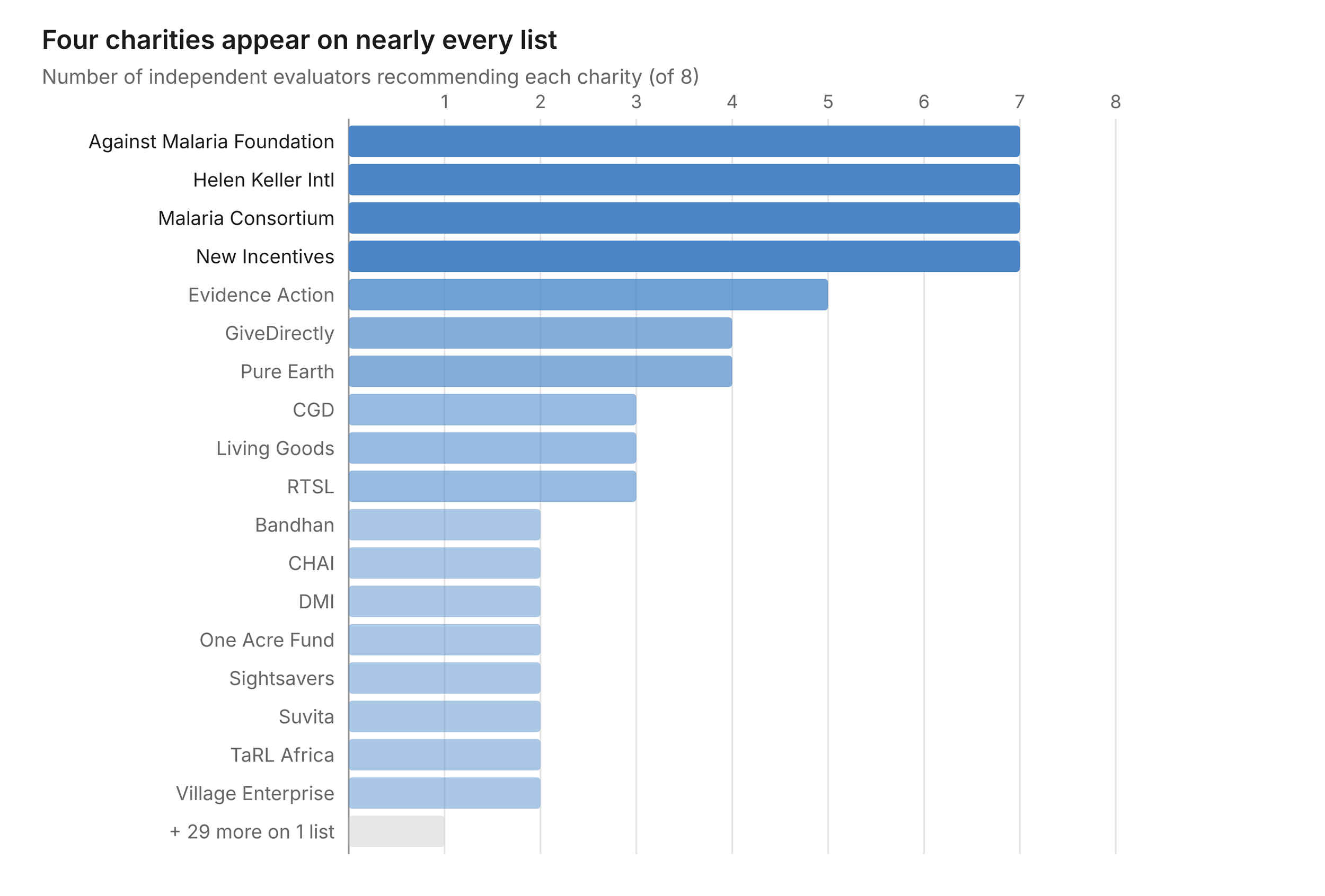
The total universe across all twenty-one platforms numbers forty-eight charities. Three of the core four are recommended by twenty of twenty-one evaluators, the fourth by seventeen. Half of all charities appear on a single evaluator's list.
This is not what a diverse, independently operating evaluation ecosystem would produce. It is a small core of consensus, a thin ring of broader picks anchored on that same core, and a large number of distribution platforms echoing the whole.
Why the universe is so narrow
This convergence is the product of several reinforcing dynamics, each individually reasonable, that together produce a recommended-charity universe far narrower than the effective-charity universe.
The first is resource constraints. Genuine cost-effectiveness analysis at the depth GiveWell pioneered is extraordinarily resource-intensive. It requires specialist researchers, extended engagement with programme data, and the analytical infrastructure to model cost-per-outcome across different interventions and contexts. Very few organisations can afford to do this from scratch. So most evaluators – particularly the smaller, country-specific platforms – sensibly rely on what already exists rather than duplicating it.
The second is methodological alignment. The effective altruism community tends to cohere around a particular philosophical framework: maximise expected value per dollar, privilege quantifiable outcomes, weight RCT-grade evidence heavily. Evaluators that emerged from or adjacent to that community naturally adopt compatible methodologies, which means they land on compatible recommendations even when they are not explicitly borrowing from one another. So the alignment sits in the shared assumptions about what counts as evidence and what counts as impact.
This alignment has a specific consequence, which is the third dynamic: evidence-type bias. The dominant methodology privileges interventions where cost-effectiveness can be modelled in a specific way – typically health interventions with well-established DALYs-per-dollar estimates derived from randomised controlled trials. This design choice produces high-confidence recommendations within its scope. But it means that entire categories of effective work are structurally invisible: policy and governance interventions where attribution is diffuse, systems-strengthening work where the causal chain is long, community-based programmes where the evidence is strong but not RCT-shaped, and locally adapted delivery models in contexts where the measurement infrastructure has not yet caught up.
The fourth is network effects and legitimacy. If you are launching a new evidence-led giving platform in Norway or Belgium or Hong Kong, recommending the same charities as GiveWell and Giving What We Can is a legitimacy signal. It tells donors you are part of the credible ecosystem. Recommending an organisation that nobody else recommends is a reputational risk – you are vouching for it alone.
The fifth is the pipeline problem. Even if a new evaluator wanted to recommend different organisations, where would they find them? There is no systematic pipeline for identifying, diligencing and surfacing effective organisations that sit outside the current evaluator universe. The handful of distinctive recommendations in the long tail – organisations appearing on just one or two lists – got there because a single evaluator with a differentiated methodology did some bespoke research. There is no infrastructure for discovering the next tier at scale.
What sits outside
A reasonable challenge is that maybe the evaluators all recommend the same charities because those charities genuinely are the best. We think this is a legitimate possibility. But even if we accept that these are the best, the fact that they are privileged on these lists means that hundreds of organisations that might be 80% or 90% as effective as them end up receiving only 5%-10% of as much resources. The result being that a great deal of potential impact is left on the table.
These are not necessarily obscure outfits either. They include organisations delivering proven health interventions in geographies that GiveWell has not yet modelled. They include education and livelihoods programmes with strong quasi-experimental evidence that does not meet the RCT threshold. They include systems-change and policy organisations whose impact is real but whose causal attribution does not fit neatly into a cost-per-DALY framework. They include locally led organisations whose delivery models are adapted to context in ways that global evaluators are not yet equipped to assess.
What this means for donors
For a donor that cares about a cause that the current evaluator universe covers well, you have excellent options. The evaluators have done the work, the recommendations are credible, and the giving infrastructure is well developed.
But if you care about girls' education in South Asia, or climate resilience in the Pacific, or First Nations outcomes in Australia, or any of dozens of other causes where effective organisations exist but evaluators have not yet looked – you are largely on your own. There is no credible intermediary who has done the curation and can present a coherent allocation that meets your outcome goals. And, so, the transaction costs of converting your intent to give into actual, well-directed giving remain prohibitively high.
The design that needs expanding
The evidence-led charity evaluators have done (and continue to do) highly impactful work. They have built rigorous methodologies and directed billions of dollars toward interventions that demonstrably save and improve lives.
But through a series of (individually reasonable) choices about methodology, evidence standards, risk appetite and resource allocation, the end result is a recommended universe that is far narrower than what is likely to be the effective universe.
Expanding it means building the infrastructure to systematically identify and assess effective organisations beyond the current evaluator universe. It means developing methodologies that can evaluate impact across a broader evidence continuum. And it means assembling those organisations into curated, thematic portfolios that give donors the product they have been missing: a credible, evidence-informed way to fund the outcomes they care about.